
Hours-not-months is a target. A documented cell with baseline hours against ATOM hours is still to come. The other two figures are from the simulations below.
From a description to a validated cell.
Most of the cost of a robot cell is the months of engineering before it runs. ATOM compresses that front end.
DescribeWrite the application in plain language: parts, fixtures, conveyor, robot and task. ATOM turns it into a structured workcell specification.
Write the application in plain language: parts, fixtures, conveyor, robot and task. ATOM turns it into a structured workcell specification.
AssembleA deterministic assembler builds the Isaac Sim model from real, dimensionally correct equipment models.
A deterministic assembler builds the Isaac Sim model from real, dimensionally correct equipment models.
ValidateCheck reach, collisions and cycle time in simulation before anything is bought.
Check reach, collisions and cycle time in simulation before anything is bought.
GenerateProduce controller motion and logic from the same validated spec, so the cell you approved is the cell you get.
Produce controller motion and logic from the same validated spec, so the cell you approved is the cell you get.
AI reads the intent. Math builds the cell.
The language model interprets what you asked for. It never generates geometry, coordinates or motion. Every dimension comes from real asset data, so there are no invented reach envelopes.
It does not replace a controls engineer or a safety assessment. It is not an autonomous robot brain: the output is a conventional, readable robot program. It is not a runtime, because once the code is on the controller it is your controller's program.
Multi-agent orchestration
Describe what you need. ATOM figures out how.
ATOM uses a multi-agent AI pipeline to turn your plain-language cell description into a structured simulation. Each agent handles one job — parsing the request, selecting equipment, laying out the cell, generating motion — so the system is auditable and deterministic where it matters.
Simulation code generation
Generates Isaac Sim scene code from the workcell specification. No manual scripting.
Optimises paths using cuMotion GPU planning. Measures cycle time and joint loads from the physics engine.
Produces vendor-specific robot programs (ABB RAPID, FANUC TP/Karel, KUKA KRL) via ROS2 Bridge from the same validated spec.
Real cells, simulated in ATOM.
Each entry is a simulation run with its own video. New simulations are added here as they are completed.
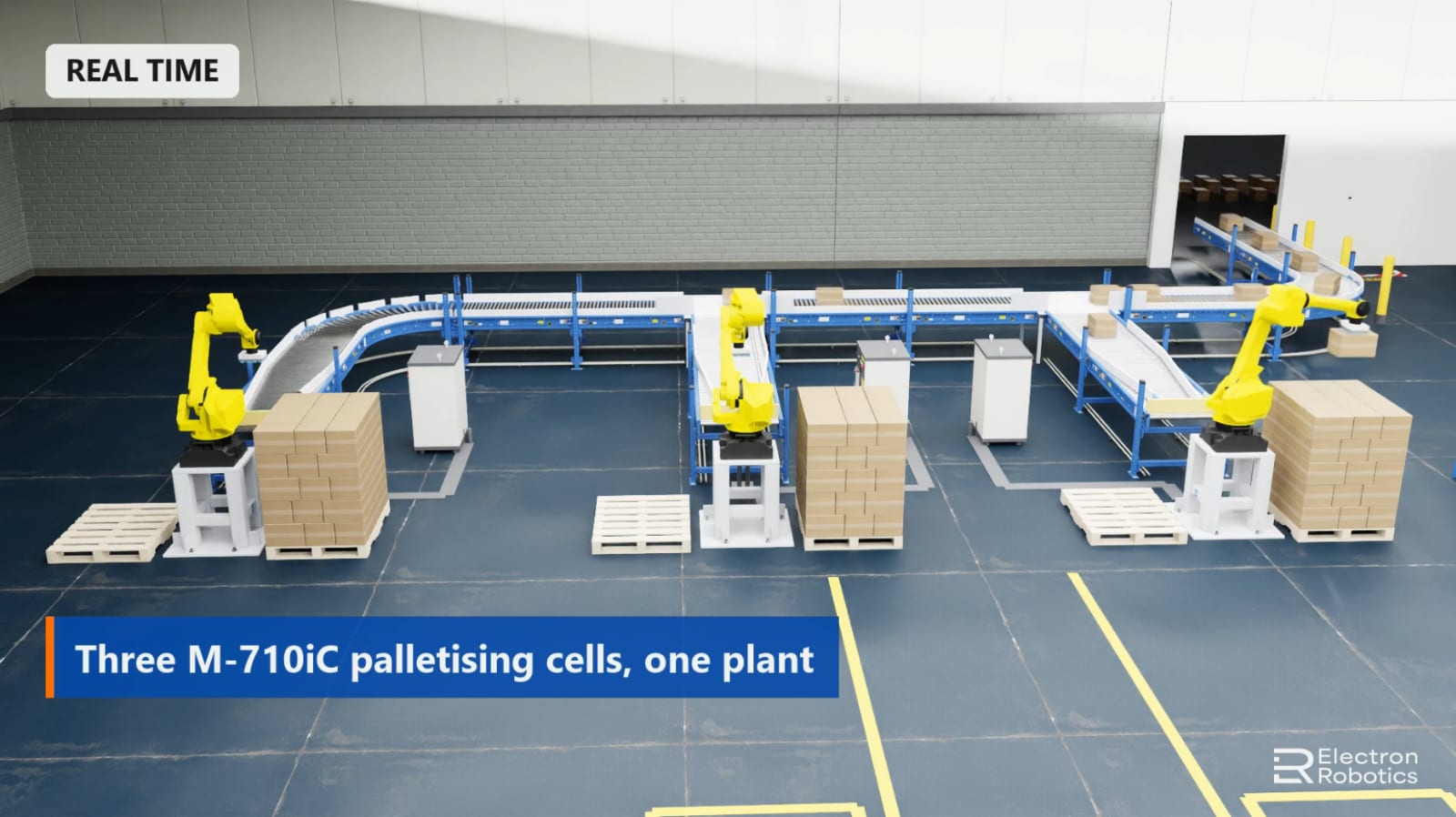
Palletizing line, three FANUC cells
Three M-710iC/50 robots on Electron risers, a stretch wrapper, pallet dispenser and forklift in one plant. Includes a robot swap to the R-2000iC/210F and a fault caught before build.
122 placements measured in the swap comparison
Read the case study · Watch the video
Solder paste dispensing, ABB IRB 1200
An ABB robot dispenses paste onto 32 pad targets on a circuit board, ahead of a reflow station. Four virtual cameras show the cell, the robot, the paste and the result.
Additional cells and applications will appear here, each with its video and the robots used.
Case study · Palletizing line
Everything below comes from one simulated palletizing line: three FANUC cells, a wrapper, a dispenser and a forklift.
Caught in simulation · Palletizing line
See why a cell fails before you build it.
A three-robot FANUC M-710iC palletizing cell on Electron risers, running in ATOM. On pallet two, layer 3, one carton could not be placed.
Bench run, 2026-09-30. Every carton, robot and second is logged in a run record.
Swap a robot, keep the cell · Palletizing line
Change the robot. Re-run the same line.
Same conveyor, same pallet pattern, two robots. ATOM ran a FANUC M-710iC/50 and a FANUC R-2000iC/210F through the cell and measured every placement, so the choice is made from data before anyone orders a robot.
From the Round 2 video: 122 placements across two takes, medians only. Faster and less precise is a trade-off the layout has to accept or fix. A longer run will tighten these numbers.
The whole plant · Palletizing line
Robots, wrapper, dispenser and forklift in one run.
ATOM simulates the line around the robot too, so handoffs and queues show up in the results.
Every run is logged: each joint's angle and torque 20 times a second, every stop and fault coded, every machine's state.
Case study · Solder paste dispensing
Watch a robot dispense paste on 32 pads.
An ABB IRB 1200 places solder paste on a circuit board that then moves to a reflow station. The same run is filmed from four virtual cameras: cell overview, robot side, paste microscope and paste inspection.
Uncalibrated simulation, dispensing excerpt. Paste shape and timing are not yet calibrated to a real process, and no process results are claimed.
One spec. Several robot brands.
Controller code is generated via the ROS2 Bridge from the same validated simulation spec. Before launch, list only the brands where generated code runs end to end on request.
Built on the NVIDIA stack
Isaac Sim, Isaac Lab, Replicator and cuMotion GPU motion planning, unified behind one pipeline. ATOM is an Isaac Sim extension, not an Isaac Sim competitor.
Manufacturing analytics are built in: cycle time, success and failure rates, reachability, singularity detection, layout optimization.
Built for the people who commission robot cells.
Robot and application engineersDesign and validate cells without scripting Unity, Unreal or ROS by hand.
Automation and process engineersCompare layouts, robots and end-of-arm tooling side by side.
Technical salesShow a customer their own cell running before anything ships.
Researchers and educatorsHands-on workcell design and configuration for labs and training.
Hardware and EOAT teamsTest tooling and integration against physics-accurate models.
Risk analystsInsurers and banks reviewing the technical risk of an installation.
We'll build the cell for you.
Don't have an automation team? We design, simulate and deliver production-ready robot cells, lines and complete factories — from concept through commissioning.
Single-station workcells — pick-and-place, palletizing, dispensing, welding — designed in ATOM, validated in simulation, deployed on your floor.
Multi-cell lines with conveyors, buffers and coordinated motion, proven end-to-end in simulation before hardware is ordered.
Full-facility automation planning — robot placement, material flow, throughput modeling and safety zoning across your entire operation.
Every engagement starts with an ATOM simulation. You see the system running before a single dollar is committed to hardware.
Manufacturing data is strategic IP.
ATOM is designed for environments where workcell layouts, cycle times and process parameters are competitive advantages.
On-prem, hybrid or private cloud — deploy where your policies require.
Complete isolation by customer with no cross-tenant data access.
Fine-grained data-sharing rules for system integrators and partners on your terms.
No forced model training on your data. Your workcell designs stay yours.
Industry veterans deploying robot work cells.
Decades of hardware development, industrial robotics integration and 35+ years of manufacturing experience meets AI.
Co-founder Breeze Test Instruments (sold to Tektronix). CEO & President, Axiom Electronics, Inc. 35+ years in electronic manufacturing and product development.
U of Colorado Denver · Tektronix
M.S. Mechatronics & Robotics Engineering. Robotics Researcher at AI4CE Labs, NYU.
MOTH CTO and serial entrepreneur. Building the first consumer quantum applications.
Cornell · Dartmouth · Yale
Build the infrastructure layer for Physical AI.
We are a small, technical team solving hard problems at the intersection of robotics, simulation and AI. If you want to ship real tools that put robots to work in factories, we want to hear from you.
Work on the ATOM transpiler — translating natural-language workcell descriptions into validated Isaac Sim scenes and deterministic robot programs.
Portland, OR · Remote considered
Own the cloud pipeline that runs physics-accurate simulation at scale — GPU orchestration, CI for robot code, and deployment tooling.
Develop and validate robot motion planning, URDF/USD asset pipelines and sim-to-real workflows for industrial manipulators.
To apply, email your résumé and a brief note on what interests you to robert@electron-robotics.ai.
How we handle your information.
How we use your information
We use contact information solely to respond to your inquiry, schedule demonstrations and communicate about Electron Robotics products and services. We do not sell, rent or share your personal information with third parties for their marketing purposes.
Data from ATOM platform users
Workcell designs, simulation configurations and robot programs created through ATOM belong to the customer. We do not use customer workcell data to train AI models unless a customer explicitly opts in. See our product terms for details.
You may request access to, correction of, or deletion of any personal information we hold about you by emailing robert@electron-robotics.ai.
Questions about this policy: robert@electron-robotics.aielectr0n, Inc. · 2130 SW 5th Ave, Suite 101, Portland, OR 97201
Bring us a cell you need to prove out.
We are running controlled early evaluations. Tell us the robot, the task and the layout, and we will show you what ATOM finds.
官网:http://electron-robotics.ai
资料来源:企业官网公司简介(复核日期:2026-10-07)。